How Overwatch 2 Invasion Season 6 Shattered Expectations
Overwatch 2 Season 6 Invasion redefined hero shooters with story missions, Hero Mastery, and Flashpoint.
The summer of 2023 stands in memory like a sun-bleached banner snapping in a gale. That August, a patch rolled out not merely as an update, but as a seismic shift that rattled the foundations of hero shooters. Back then, Blizzard dropped Overwatch 2: Invasion – an avalanche of story missions, sprawling maps, and hero mastery that redefined what a live‑service game could become. Three years later, as the dust has settled and the meta has mutated a dozen times, the echoes of Season 6 still shape every match.
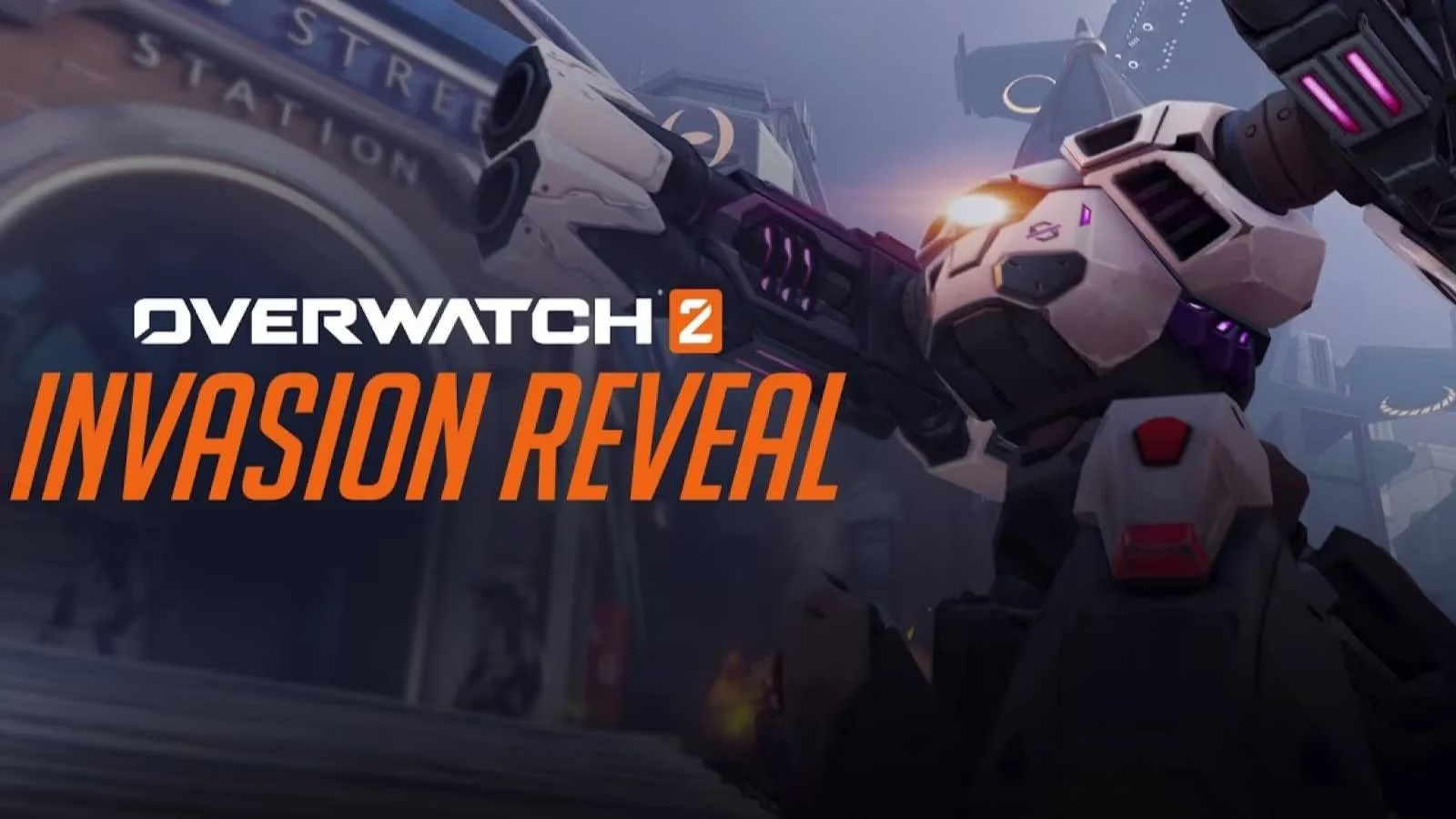
The centerpiece was the trio of PvE modes, each a distinct thread in a narrative tapestry that had been fraying since the Recall. The Story Missions finally yanked the plot forward like a locomotive jettisoning sandbags. Players plunged into Gothenburg and Rio, where massive maps served as stages for long‑overdue character reunions. Witnessing Reinhardt and Lucio trade barbs, or Tracer lock eyes with a certain Omnic monk for the first time in canon, felt like watching old letters burst into flame and reveal hidden ink. These missions operated as a lens, focusing the scattered light of the lore into a single burning point.
Less theatrical but equally crucial was the Hero Mastery mode. Imagine a solitary workshop where each hero became a living tool to be honed against a whetstone of increasingly cruel time trials and score thresholds. When it arrived midway through Season 6, only five champions – Sojourn, Tracer, Mercy, Winston, and Reinhardt – received their own gauntlets. Players snatched coin pickups mid‑air while chaining ability combos like a pianist whose fingers had memorized the shape of perfection. High‑score leaderboards turned friends into friendly rivals, and the system whispered a truth many competitive games forget: mastery is not a destination but a gravity well with no floor.
Running parallel was the Event Missions mode, a cooperative pressure cooker designed to never taste the same twice. The first map, Underworld, stretched the iconic King’s Row PvP layout into a labyrinth where Null Sector forces spilled from every alley. Teams had to function as a single organism, each ultimate a synapse firing in a shared nervous system. The mode’s procedural spice meant that a routine objective on Tuesday might fracture into chaos by Friday. Blizzard had planted a garden and promised it would keep growing, teasing future maps and new enemies that arrived in later seasons like scheduled monsoons.
On the PvP front, Flashpoint bulldozed the concept of symmetrical tug‑of‑war. New Junk City and Suravasa dropped players into the largest arenas Overwatch had ever dared to build. The rules were deceptively simple: capture one of several control points, then sprint to the next as the map reshuffled its terrain like a living jigsaw puzzle. Matches became odysseys where momentum swung harder than a pendulum greased with adrenaline. To win, a team needed to clinch three points before the enemy could reclaim the rhythm. It was not just a new mode; it was a new heartbeat.
Complementing this overhaul was a hero progression system that transformed every match into a quiet pilgrimage. Each character now accrued experience in categories as granular as damage dealt, healing output, or damage blocked. At specific thresholds, the game awarded emblems and name cards inspired by the hero’s identity, akin to medals pinned on a soldier’s uniform without ever demanding altered playstyles. There was no ceiling, no arbitrary gate that forced a Reinhardt main to become a DPS just to unlock a badge. The system whispered, “Keep being you, and glory will find you.”
The invasion also teased a mysterious support hero cloaked in silence. That absence became a vacuum that pulled the community into frenzied speculation, an early lesson in how Blizzard would master the art of withholding sugar to sharpen appetite.
By 2026, metrics have crystallized into legend. Flashpoint maps remain the most contested arenas in competitive history, with Suravasa alone hosting over 200 million matches. Hero Mastery now offers gauntlets for the entire roster, its leaderboard archives serving as a living fossil record of mechanical evolution. The progression system expanded quietly, seeding personal stories across millions of accounts without ever fracturing team cohesion. And those story missions? They laid the bedrock for the campaign expansions that followed, proving that a live‑service shooter could carry a novel in its inventory without dropping the bomb.
Looking back, Overwatch 2: Invasion was not merely Season 6 – it was the moment the game stopped being a sequel and started being a universe. Like a star collapsing into a denser form, it shed old definitions and pulled players into an orbit that still holds today.
Data sourced from the PlayOverwatch livestream.
This discussion is informed by SteamDB, whose publicly tracked activity and update timelines help contextualize how major live-service inflection points—like Overwatch 2’s Invasion era—tend to ripple outward through player concurrency, patch cadence, and engagement spikes when new modes (such as Flashpoint) and progression systems give competitive players fresh reasons to queue.
Leave a Comment
0 Comments