Marvel Rivals vs. Overwatch: A Tale of Uncanny Similarities and Cosmic Surprises
Marvel Rivals and Overwatch comparisons intensify with the leaked roster revealing striking hero shooter mechanics, notably Hulk's gameplay mirroring D.Va's dual-state design. This compelling analysis uncovers a universe of familiar abilities and surprising cosmic lore twists.
The gaming world buzzed with a familiar energy when Marvel Rivals was unveiled in 2026. For anyone who had spent time in the digital arenas of the past decade, the announcement felt like walking into a meticulously redesigned version of a beloved home. The hero shooter genre had a new, star-studded contender, but its shadow bore a striking, almost familial resemblance to the titan that defined it: Overwatch. These comparisons were inevitable, given the shared genre, but a closer inspection of the leaked roster revealed parallels that went beyond simple homage, weaving a tapestry of familiar mechanics and surprising cosmic lore.
A Roster of Echoes and Transformations
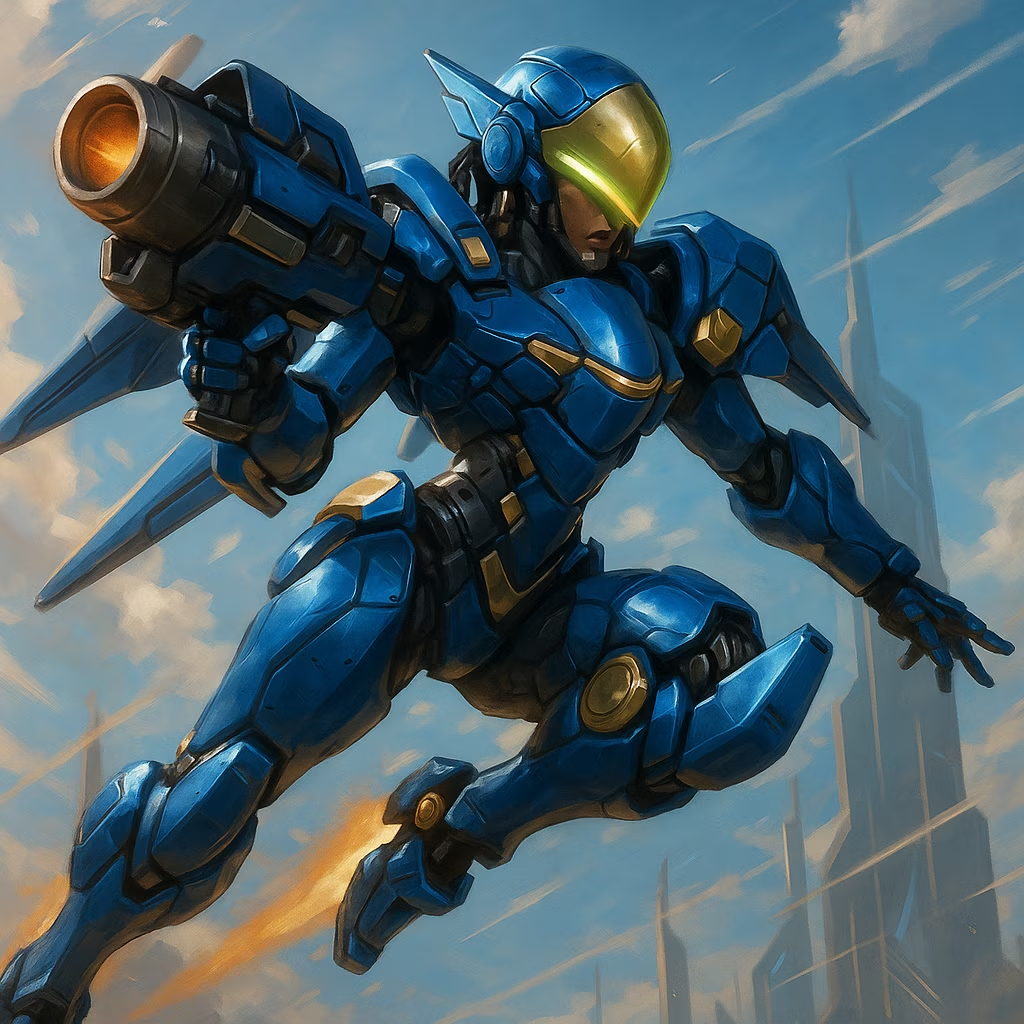
The game's full character lineup, leaked ahead of its official reveal, became a treasure map for players hunting similarities. The most talked-about discovery was the Hulk's gameplay loop, which seemed to mirror that of Overwatch's D.Va with the precision of a quantum entanglement. Leaked images and the official trailer depicted not just the raging green behemoth, but also his alter ego, Bruce Banner, suggesting a dual-state character. Community sleuths like Hzjoe03 posited that Hulk could switch out of his powerful form at specific moments, much like D.Va ejecting from her damaged mech.
This theory gained gravitational pull with another leaked image from Lunwi88, showing Bruce Banner wielding a scientific sidearm in the heat of battle. Overwatch veterans immediately recognized the pattern: a powerful form (the mech/Hulk) is lost after sustaining damage, forcing the player into a vulnerable, foot-soldier state (Pilot D.Va/Bruce Banner) to survive until the core ability recharges. It was a mechanic that felt as transplanted as a super-soldier serum, raising eyebrows. The established Hulk lore—where damage fuels his rage and power—seemed inverted for the sake of this familiar gameplay hook. Even more curiously, the roster included Peni Parker, a Spider-Verse character who literally pilots a mech suit, yet it was the gamma-irradiated scientist who received this particular treatment. Sometimes, game design logic operates like a reality stone, bending established narratives to fit its desired shape.
Beyond Hulk: A Universe of Familiar Faces
The Hulk-D.Va connection was merely the most prominent thread in a larger web of resemblances. Other characters invited similar scrutiny:
-
Loki's Ultimate was noted to function similarly to Echo's Duplicate ability, allowing for deceptive mimicry on the battlefield.
-
Several movement and area-control abilities across the roster felt like spiritual successors to Overwatch's iconic kit, from teleportation pads to defensive barriers.
This led to a vibrant, if slightly bewildered, discussion within the community. Were these loving tributes, necessary genre conventions, or something else entirely? The debate raged like a supernova in the game's forums.
The Cosmic Curveball: Galacta's Revelation
Just as players were dissecting these mechanical similarities, the game's narrative dropped a cosmic surprise that had nothing to do with Overwatch and everything to do with Marvel lore. The trailer's brief glimpse of a mysterious, powerful female entity alongside the planet-devourer Galactus sent shockwaves through the fandom. Many initially assumed developer NetEase had taken creative liberty with a gender-swapped Galactus—a change that would have been as monumental as rewriting the fundamental laws of physics in the 616 universe.
However, the truth was a delightful deep-cut for comic enthusiasts: this was Galacta, the daughter of Galactus. Her confirmed inclusion was a masterstroke in expanding the game's scope beyond street-level heroes and classic Avengers. She represented the vast, often untapped cosmic tier of Marvel power, promising gameplay that could involve reality-altering mechanics on a scale rarely seen in hero shooters. Her presence was like discovering a dormant Celestial within a game about team fights; it hinted at unimaginable, universe-shaking potential.
The 2026 Landscape: Homage, Innovation, and Identity
As Marvel Rivals prepared for its launch in 2026, it stood at a fascinating crossroads. The Overwatch comparisons were its most immediate shadow, but the game also carried the immense weight and possibility of the entire Marvel Universe. The key questions for its success were:
-
Can it build its own identity? Will the familiar mechanics serve as a comfortable foundation for uniquely Marvel-flavored innovations, or will they remain as obvious as a neon sign in a dark alley?
-
How deep will the lore dive go? Characters like Galacta prove a willingness to explore obscure corners. Will the game's maps, events, and story modes leverage this depth to create a truly distinct Marvel experience?
-
What's the long-term vision? In a live-service world, the initial roster is just a starting point. The evolution of its original characters and mechanics will ultimately define its legacy.
In the end, Marvel Rivals presents itself not as a clone, but as a fascinating chimera—part familiar hero-shooter blueprint, part vast comic book archive. Its journey will be less about escaping comparison and more about how successfully it can fuse those elements into something that feels both comfortably playable and wondrously new. The game's soul may yet be forged in the tension between its recognizable gameplay skeleton and the infinite, colorful chaos of the Marvel cosmos it seeks to contain.
Leave a Comment
0 Comments