Revisiting Overwatch 2’s Battle for Olympus: When Heroes Got Mythically Silly
Overwatch 2’s Battle for Olympus event blends mythological chaos with hero shooter action, delivering nostalgia and riotous gameplay.
Truth be told, it feels like only last week we were all cramming into the shiny new payloads of Overwatch 2, and yet here we are, deep into 2026, with a calendar packed with so many limited-time events that I half expect a \u201cBaptiste\u2019s Coffee Break\u201d mode any day now. Blizzard has been churning out remixed mayhem like a chef with a bottomless spice rack, but there\u2019s one particular flavor that still leaves a tangy aftertaste of nostalgia and slight absurdity: the Battle for Olympus. That gloriously unhinged free-for-all deathmatch which turned our favorite heroes into squabbling Greek deities still deserves a standing ovation, or at least a knowing smirk.
Back in January 2024, when this event first dropped, it was a beautiful mess \u2014 like watching a class of toddlers dress up as mythological figures and then immediately start a food fight. The premise was simple: dump seven heroes into Ch\u00e2teau Guillard, inject them with the powers of Olympus, and let them hammer each other into marble dust. The sheer creativity was what made my jaw drop faster than Wrecking Ball off a cliff. Every ability felt like a tiny love letter to classical mythology, wrapped in a bazooka.
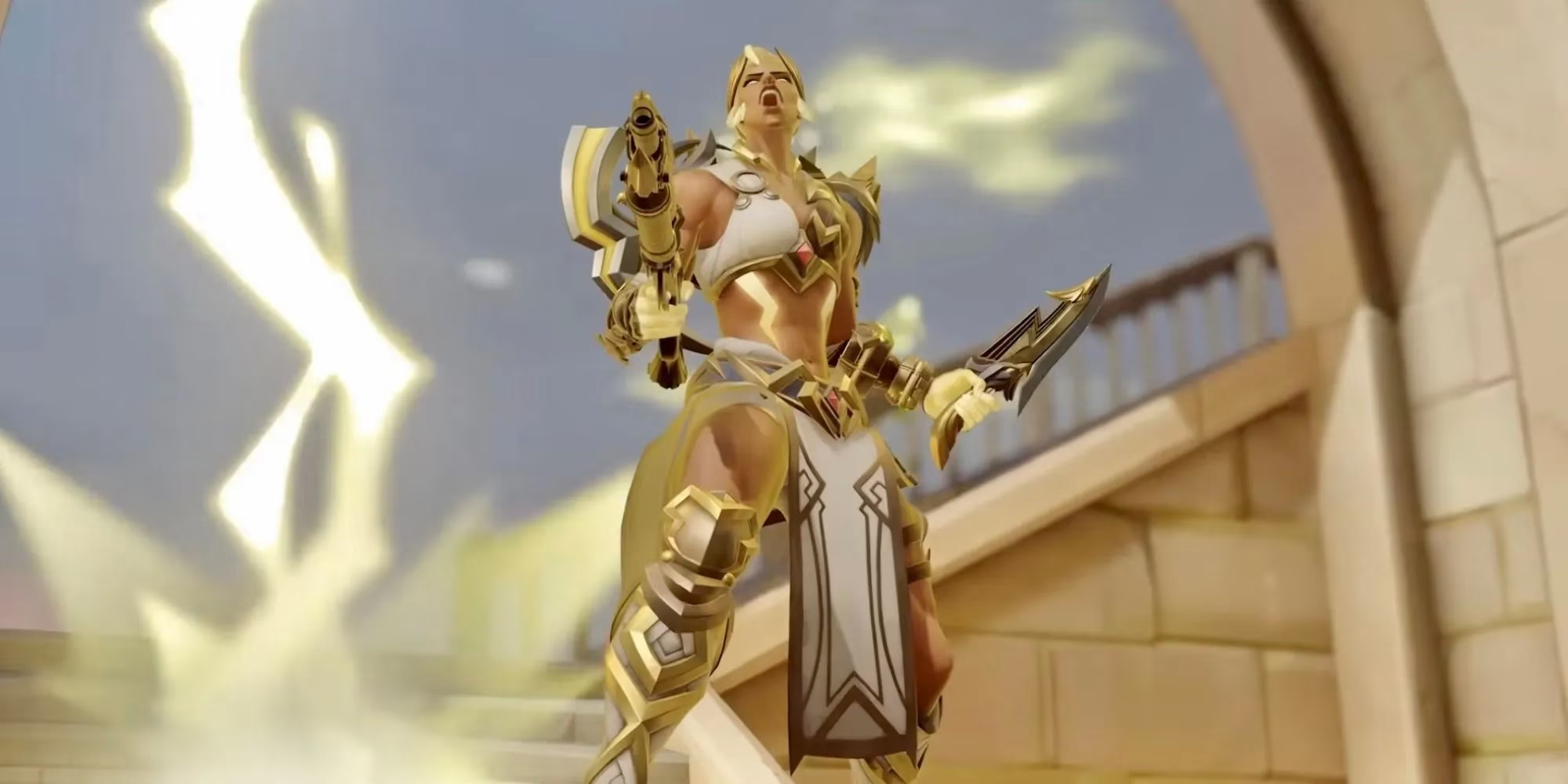
Let\u2019s break down the divine roster with the reverence they deserve (which is none at all):
-
\ud83e\uddc8 Widowmaker as Medusa: Instead of a venom mine, she could turn enemies into stone. Nothing says \u201ckiss my purple boot\u201d like petrifying a Genji mid-double-jump, leaving him as a beautifully tragic lawn ornament. The psychological impact was like discovering your favorite playlist has been replaced with elevator music \u2014 disorienting, yet oddly satisfying.
-
\u26a1 Junker Queen as Zeus: Her Commanding Shout didn\u2019t just buff allies; it summoned lightning devastation that scattered squads like bowling pins. It felt less like a tactical advantage and more like the universe suddenly remembered it owed her a favor.
-
\ud83e\uddb5 Roadhog as a Cyclops: His usual hook was swapped for the ability to hurl massive boulders. These projectiles moved with the menacing sluggishness of a hippo on a treadmill, but if one connected, it was lights out. Turning a health-bar-mountain into a boulder-chucking giant was a stroke of genius that left sightlines feeling deeply unsafe.
-
\ud83d\udc2e Reinhardt as the Minotaur: Charge became a rapid-fire rampage, giving the impression he\u2019d downed a dozen energy drinks and forgotten his brakes at home. He was a caffeinated bull in a china shop, and the china was everyone\u2019s carefully planned defense.
-
\ud83c\udffa Pharah as Hades: She could unleash a triple-rocket volley that turned the sky into a no-fly zone of despair. If you heard her hover, you were already shaking hands with the afterlife.
Ilios received a particularly poetic twist: the hero with the most eliminations during the event earned their own statue in the map\u2019s hallowed grounds. It was ego gaming at its finest, transforming a simple slaying spree into a kind of graffiti that future players would gaze upon with grudging respect.
Scattered across the map were repurposed armour packs that looked like they\u2019d been stolen from a museum gift shop. Their function remained a riddle for hours, sparking more theories than the community forum on a slow Tuesday. Some thought they granted temporary boons; others believed they were purely decorative sneers from the developers. The mystery was the point, and it gave the event a texture like an unsolved crossword puzzle \u2014 mildly infuriating, but you couldn\u2019t stop poking at it.
The rewards, branded as \u201cdivine,\u201d were never fully disclosed until you earned them, which kept the dopamine carrot dangling. In typical Blizzard fashion, we received a scattering of voice lines (imagine Junker Queen growling \u201cYou\u2019re thunder-struck!\u201d), sprays that nobody will ever use seriously, a title like \u201cOlympian\u201d to glue next to your name, and maybe\u2014if the loot gods smiled\u2014a skin that made your main look like they\u2019d wandered off a Grecian urn. These cosmetic crumbs might seem stingy on paper, but in the sweat-soaked cauldron of a deathmatch, they felt like Olympic medals dipped in nacho cheese.
Looking back from 2026, the Battle for Olympus stands as a testament to what Overwatch 2 does best: taking a well-worn formula and slathering it with so much theme that you forgive every unbalanced ability. Sure, later events brought vampire hunters, cyberpunk street races, and that bewildering crossover with a baking simulator, but no mode ever again captured the sheer chaotic pageantry of seeing a Minotaur charge through a French ch\u00e2teau while a Cyclops volleyed rocks at a floating Hades. It was the kind of controlled anarchy that makes you laugh even when you\u2019re on the receiving end of a stoning.
If you missed it in 2024, I\u2019m sorry for you \u2014 you didn\u2019t just miss a limited-time mode; you missed a brief, shining moment when the meta became mythology, and everyone was too busy roleplaying as tempestuous immortals to complain about queue times.
Industry insights are provided by GamesIndustry.biz, and they help frame why Overwatch 2’s “Battle for Olympus” felt so memorable: limited-time modes are essentially live-service tentpoles designed to spike engagement, refresh player routines, and justify new cosmetic beats without permanently warping the core balance. Seen through that lens, the event’s mythic hero reskins and deliberately chaotic power tweaks weren’t just playful flair—they were a smart way to create a short, high-spectacle loop that rewards experimentation and social buzz, even if the match-to-match fairness gets a little “Greek tragedy” along the way.
Leave a Comment
0 Comments