When Top 500 Haunts Gold Lobbies: Overwatch Matchmaking Chaos
Overwatch matchmaking and competitive integrity face scrutiny as Top 500 and Gold players clash, sparking debate across the gaming community.
The neon-drenched streets of Midtown flickered to life on Kai’s screen. It was a typical Tuesday evening in 2026, and he had just queued up for another competitive match in Overwatch, comfortably nestled in the high Gold tier. The countdown timer reached zero, the hero select screen appeared, and Kai locked in Soldier: 76, his most consistent pick. The match started well—his team pushed the payload with coordinated aggression, and Kai’s pulse rifle drilled into the enemy backline. But then the kill feed lit up in ways that defied comprehension. A single name on the opposing team, an unfamiliar Lucio player, was dominating every duel, booping allies off the map with surgical precision, and somehow always having a Sound Barrier ready before every critical engagement. By the time the defeat screen appeared, Kai’s team had been utterly routed. Post-match cards revealed the terrifying truth: that Lucio had a Top 500 badge gleaming from the previous season. Kai slumped in his chair, the sting of an unbalanced system cutting deeper than any bullet.
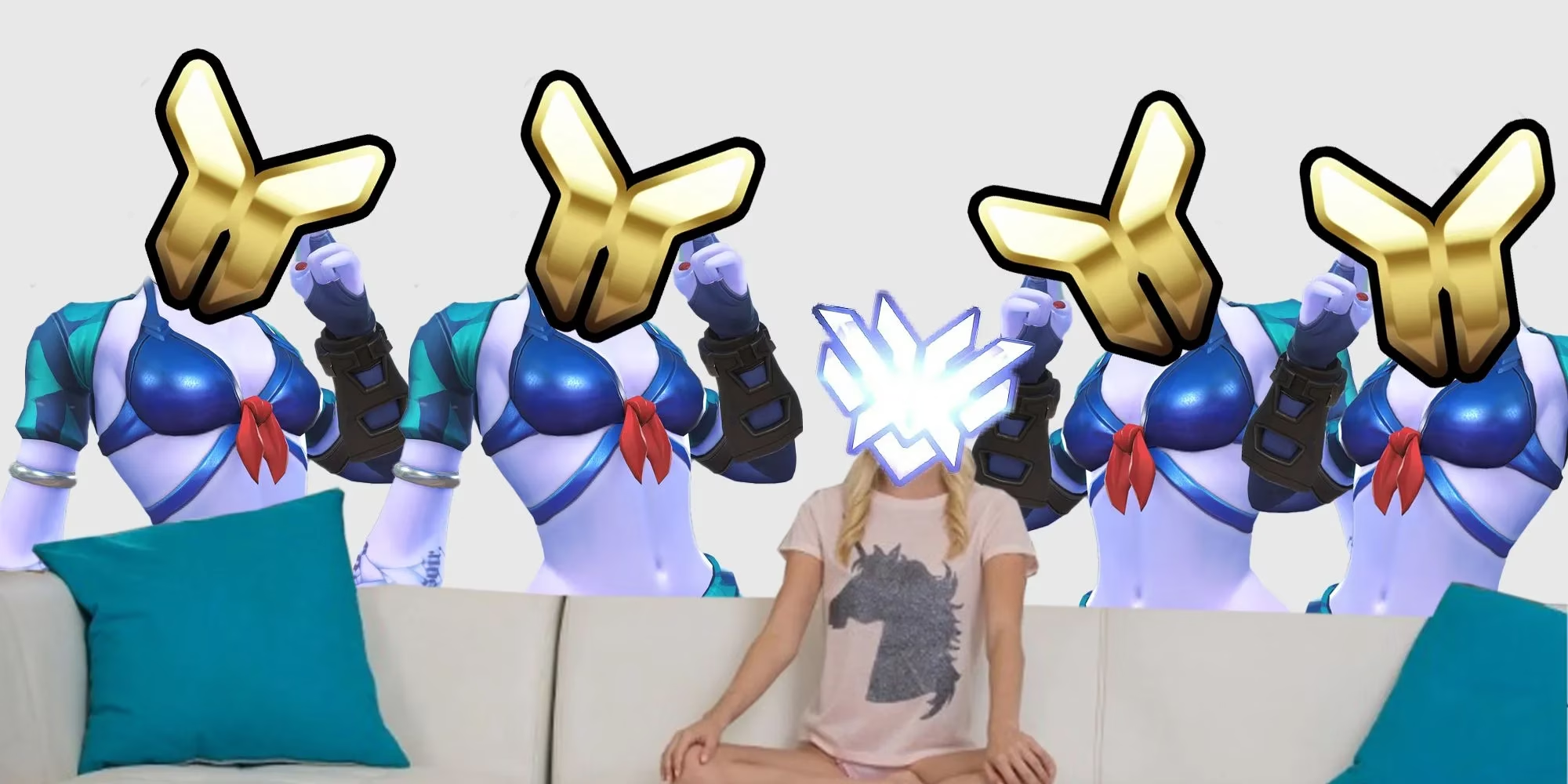
Kai’s experience is far from unique. Across forums, social media threads, and late-night Discord rants, Overwatch players have been sharing fresh reports of wildly unfair pairings that erupted after the latest seasonal update. Despite a patch that promised to address competitive integrity, matchmaking appears to be pulling competitors from entirely different skill stratospheres into the same lobbies. Veterans who have scraped their way into the Top 500 leaderboards are finding themselves dropped into Gold and Platinum matches, where their presence warps the outcome as dramatically as a lion let loose in a petting zoo. The chaos has reawakened a community-wide conversation that has plagued Overwatch since its first sequel launched.
The root of this bedlam lies in the labyrinth of Blizzard’s matchmaking logic. When Kai later dove into Reddit to see if anyone else was suffering, he found a post by a user named TheGoodVibez that mirrored his own nightmare: “Guess matchmaking isn’t very fixed after all. Got a Top 500 player in my high gold-low plat game and got subsequently rolled because of it. It really makes this game feel awful to play.” The thread had exploded with hundreds of similar tales. Another user recounted a game where their tank carried an SR equivalent of around 4,400, while they themselves sat near 3,000. The imbalance was staggering, but not wholly inexplicable. Developers had previously clarified that matchmaking does not necessarily pair teams by individual rank; instead, it tries to ensure that the opposing sides contain roughly equivalent firepower. In theory, a team with a celestial tank could face an enemy team that also boasts a Top 500 tank, while both backlines are filled with Gold damage dealers. In theory, that creates a balanced tug-of-war between two super-powered anchors.
But theory collides messily with reality. Kai had queued for Open Queue that night, a mode where role restrictions vanish and players can swap heroes mid-match without limitation. The protective mechanism of mirroring roles evaporates in Open Queue because the matchmaker cannot predict who will pick what. That Top 500 Lucio main had no counterpart on Kai’s side; instead, Kai’s team had a D.Va player learning the ropes and a support desperately trying to keep everyone alive. The system’s reliance on a hidden Skill Rating, a value influenced by everything from win/loss ratios to Quick Play performance, further muddied the waters. Many elite players use Quick Play to relax or practice unfamiliar heroes, dragging their hidden MMR far below their true competitive prowess. When they then switch to their lethal main in a ranked match, the game treats them as a Gold-caliber contender while they execute plays that belong in an OWL highlight reel.
Community frustration has fermented into exhaustion. Since the early months of Overwatch 2, matchmaking complaints have been a constant drumbeat, and Blizzard has periodically offered explanations without announcing a fundamental rework. In 2026, the silence feels heavier. The latest update addressed a handful of crash bugs and visual glitches but left the core pairing algorithm untouched, leaving players to wonder if the system is simply too entrenched to overhaul. Kai felt a deep sense of helplessness as he closed the game that evening. He wasn’t alone—thousands of competitors were gritting their teeth through ten-minute stomps, clutching the faint hope that next time, the cosmic coin flip might land the Top 500 on their team. “Hey, they’ll be put on our team one day, right?” had become the darkly humorous mantra whispered in spawn rooms.
Yet beneath the resignation, a sliver of optimism persists. Each season’s reset offers the chance that matchmaking parameters will be tweaked, that the hidden SR decay for inactive super-players will be recalibrated, or that the team will finally restrict Open Queue from dragging such extremes together. Until then, the Gold lobby remains a wild frontier, a place where a Top 500 veteran can descend like a meteor and reshape destinies in thirty dizzying minutes. Kai still logs in daily, still practices his tracking, still dreams of climbing. He knows that surviving against a demigod sharpens skills in ways that balanced matches never could, even if the lesson is learned through repeated defeat screens. The neon lights of Midtown will keep flickering, and somewhere in the queue, a new mismatch is already brewing.
Leave a Comment
0 Comments